
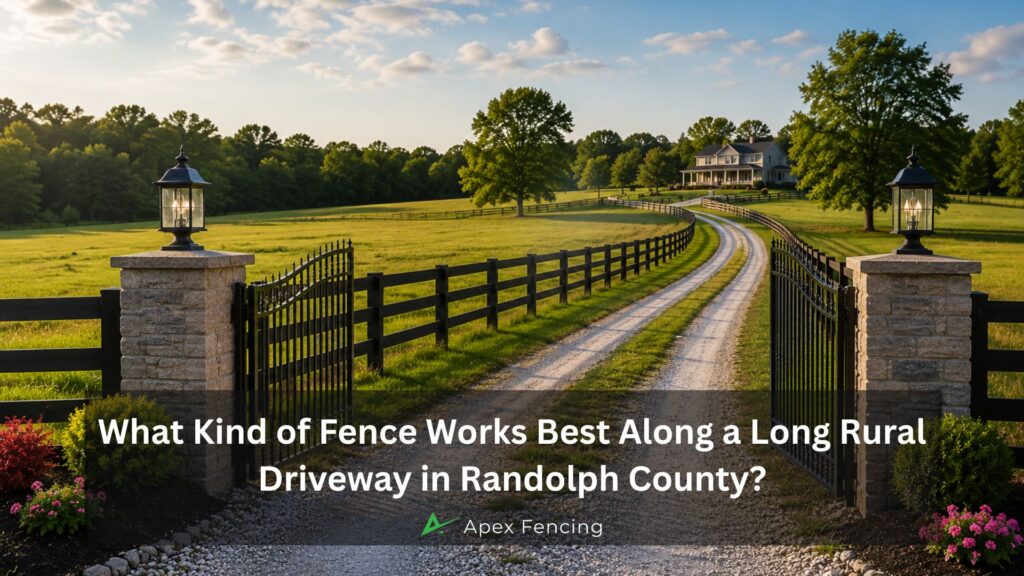
A long rural driveway needs a different fence plan than a small backyard. In Randolph County, many properties have wide entrances, wooded edges, open land, long gravel drives, farm-style layouts, or larger front yards. That means the fence has to do more than mark a boundary.
For some homeowners, the goal is curb appeal near the entrance. For others, it is security, privacy, pet control, or a cleaner way to separate the driveway from the rest of the property. The right fence depends on how the driveway is used, how much of it needs to be fenced, and what the homeowner wants people to see from the road.
Key Takeaways
- A long driveway fence should balance appearance, access, visibility, privacy, and cost.
- You may not need the same fence material along the entire driveway.
- Gate placement is one of the most important parts of the layout.
- Chain link, aluminum, wood, and mixed-material layouts can all work depending on the property.
- The best choice depends on whether the fence is for security, curb appeal, pets, privacy, or property definition.
A Long Driveway Fence Has a Different Job Than a Backyard Fence
Backyard fences are usually built for privacy, pets, kids, pools, or outdoor living areas. A driveway fence has a different purpose.
Along a long rural driveway, the fence may need to:
- Define the entrance from the road
- Improve curb appeal
- Create a clear property boundary
- Control access to the home or land
- Keep pets away from the driveway
- Separate parking areas from open yard space
- Add privacy near the house
- Protect equipment, storage areas, or work vehicles
- Guide visitors toward the correct entrance
That is why the first question should not be “What fence looks best?” The better question is: What does this fence need to do?
A driveway fence near the road may need to look clean and welcoming. A fence farther back near a utility area may need to be more practical. A section near the home may need privacy. Each part of the driveway may have a different job.
Start With the Entrance
For many rural properties, the entrance is the most visible part of the fence. It is the first thing guests, neighbors, delivery drivers, and passersby see.
A clean entrance fence can make the property look more finished without fencing the entire driveway the same way.
Good entrance fence options may include:
- Aluminum fencing for a clean, open look
- Wood fencing for a warmer, more traditional style
- Vinyl fencing for a simple, clean appearance
- Custom gates for a more defined entry point
- Shorter decorative sections near the road
This section does not always need to be the most private. In many cases, homeowners want the entrance to look open, clean, and easy to navigate.
A full privacy fence at the entrance may feel too closed off, especially if the driveway is long and the home sits back from the road. But a decorative or semi-open fence can mark the property without making it feel boxed in.
Chain Link Works Well for Practical Long Runs
Chain link can be a strong option for long driveway areas where the main goal is boundary, security, or function. It is especially useful when the homeowner wants visibility while still creating a clear separation.
Chain link may work well along a rural driveway if:
- The fence needs to cover a longer distance
- Visibility matters
- The homeowner wants a practical boundary
- Pets need to stay away from the driveway
- The property has wooded or open edges
- The fence is near a work area, storage area, or equipment zone
Black-coated chain link can look cleaner than older silver chain link and may blend better with landscaping. For larger properties, that can be helpful because the fence does its job without drawing too much attention.
Chain link is not always the best choice for the main entrance if the homeowner wants a more decorative look. But for long side runs, wooded edges, or practical boundaries, it can make a lot of sense.
Aluminum Gives the Entrance a Clean Look Without Blocking the View
Aluminum fencing works well when the homeowner wants the driveway entrance to feel open and polished. It can define the property line without blocking the view of the home, landscaping, or front yard.
Aluminum may be a good fit if the goal is:
- Curb appeal
- A clean entryway
- Visibility from the road
- A low-maintenance look
- A decorative boundary
- A fence that does not feel too heavy
For rural homes, aluminum can work especially well near the front entrance, driveway gate, or areas close to the house. It gives structure to the property without creating a solid wall.
It may not provide privacy, so it is not the best choice if the main concern is blocking road views or screening a busy area. But for homeowners who want a clean, open entrance, aluminum is often worth considering.
Wood Can Add Privacy, Warmth, and a More Natural Look
Wood fencing can be a good option along a driveway when the homeowner wants more privacy or a more traditional appearance. It can also work well near the home, around patios, beside parking areas, or along sections where neighbors or passing traffic can see into the property.
Wood may make sense if the homeowner wants:
- More privacy near the house
- A natural look that fits wooded land
- A warm, traditional fence style
- A way to block views from the road
- A fence that can be stained to match the property
- A stronger visual boundary around outdoor spaces
A full wood privacy fence along a very long driveway may not always be necessary. It can also make the property feel more closed in if used everywhere.
A better approach may be to use wood only where privacy matters most, then use a more open or practical material for the longer sections.
Vinyl Can Work for Clean Privacy Sections
Vinyl fencing can be useful for driveway areas where the homeowner wants a clean privacy screen without the same maintenance needs as wood. It is often used near homes, patios, side yards, or areas where a solid privacy barrier is needed.
Vinyl may work well if:
- The homeowner wants a clean, uniform look
- Privacy is needed near one part of the driveway
- The fence is close to the house
- The homeowner wants a solid panel style
- The section is not too long or visually heavy
For a long rural driveway, vinyl may be best used in selected areas instead of the full run. For example, it may work near a parking area, outdoor living space, side yard, or neighbor-facing section.
Used carefully, vinyl can provide privacy without making the entire driveway feel closed off.
Mixed-Material Layouts Often Make the Most Sense
For long rural driveways, one fence material does not always need to do everything. In fact, using one material everywhere can sometimes make the project more expensive, less practical, or less attractive.
A mixed-material layout can be smarter.
For example:
- Aluminum near the entrance for curb appeal
- Chain link along a wooded edge for practical boundary
- Wood privacy fence near the house
- Vinyl privacy fence beside a patio or parking area
- Custom gate at the driveway entrance
- Open fencing where views should stay visible
This approach helps the fence match each part of the property. The entrance can look polished. The long run can stay practical. The home-facing area can feel more private.
A mixed layout can also help homeowners avoid overbuilding. Not every foot of a long driveway needs the most decorative or most private fence option.
Driveway Gates Should Be Planned Before the Fence
A driveway gate should not be treated as an afterthought. On a rural property, the gate may be one of the most used and most important parts of the fence.
Before choosing the fence layout, homeowners should think about:
- Where vehicles enter and turn
- How wide the driveway is
- Whether delivery trucks need access
- Whether trailers, mowers, or work vehicles use the driveway
- Whether the gate should swing or slide
- How much space the gate needs to open
- Where the strongest posts should be placed
- Whether guests can easily find the entrance
A gate that is too narrow can become a daily problem. A gate placed too close to a slope, ditch, curve, or tight turn can also be frustrating.
For rural driveways, access matters. The fence should make the property feel more controlled, not harder to use.
Think About Visibility From the Road
Visibility is important along rural driveways. Some homeowners want privacy from the road. Others want the home, entrance, or landscaping to stay visible.
Before choosing a fence, ask:
- Do you want to block the view from the road?
- Do you want drivers to see the driveway entrance clearly?
- Do you want to keep the property feeling open?
- Are there curves, hills, trees, or ditches near the entrance?
- Will a tall solid fence make it harder to see when pulling out?
A privacy fence may work well near the house or side yard, but it may not be the best choice right at the road if visibility is needed.
Open fencing, such as aluminum or chain link, can help define the driveway while keeping sightlines clear.
Think About Pets and Children Near the Driveway
For some homeowners, the main concern is keeping pets or children away from the driveway. In that case, the fence layout should be planned around safety and daily movement.
Important details include:
- Fence height
- Bottom gaps
- Gate latches
- Spacing between pickets
- Where pets usually run
- Whether the driveway splits the yard
- Whether a separate backyard enclosure makes more sense
A long driveway fence may not always be the best pet solution by itself. Sometimes the better plan is to fence a backyard or side-yard area separately, then use driveway fencing for entrance control or property definition.
The right answer depends on how the property is laid out.
Do You Need to Fence the Whole Driveway?
Not always.
This is where homeowners can save themselves from an overbuilt layout. A long driveway does not always need fencing from the road all the way to the house.
Sometimes it makes more sense to fence:
- Only the entrance
- One side of the driveway
- A section near the home
- A parking or equipment area
- A pet area away from the driveway
- A privacy section near the road
- A boundary near a neighboring property
Fencing the entire driveway may be useful for some properties, but it should not be the default plan. The layout should match the actual reason for the fence.
Questions to Ask Before Choosing a Driveway Fence
Before moving forward, homeowners should answer a few practical questions.
What is the main purpose of the fence?
Is it for privacy, security, pets, curb appeal, property lines, or access control? The answer will guide the material and layout.
How much of the driveway really needs fencing?
A full driveway fence may not be necessary. Some properties only need fencing near the entrance or near the home.
Do you want the property to feel open or private?
Open fencing works better for visibility. Solid fencing works better for privacy.
Will large vehicles need access?
Think about trailers, delivery trucks, emergency vehicles, work trucks, and lawn equipment.
Where should the gate go?
Gate placement should work with the driveway width, turning space, and daily use.
Is the land flat, sloped, wooded, or uneven?
The terrain can affect post placement, gate function, and the final look of the fence.
Should more than one fence material be used?
A mixed layout may give better results than using one material everywhere.
Common Mistakes With Long Driveway Fences
A driveway fence can improve a property, but poor planning can create problems.
Common mistakes include:
- Choosing a material before deciding the fence’s purpose
- Using privacy fencing where visibility is needed
- Installing a gate that is too narrow
- Placing the gate in an awkward location
- Fencing the entire driveway when only one section needs it
- Ignoring slopes, ditches, or drainage areas
- Forgetting delivery and service vehicle access
- Using the same fence style everywhere even when the property has different needs
The best driveway fence is not always the biggest or most expensive option. It is the one that works with the land, entrance, and daily use of the property.
When a Custom Driveway Fence Layout Makes Sense
A custom layout may be the right choice if the property has:
- A long gravel or paved driveway
- A wide rural entrance
- Open land near the road
- Wooded edges
- Equipment or storage areas
- A home set far back from the road
- Pets that need separation from the driveway
- A need for both privacy and visibility
- A driveway gate or custom entrance
- Different fence needs in different sections
For these properties, a simple straight fence may not be enough. The fence needs to be planned around access, appearance, and function.
Final Thoughts
A long rural driveway in Randolph County needs a fence plan that fits the property, not just a standard material choice. Chain link may be right for long practical runs. Aluminum may be better near a clean entrance. Wood or vinyl may make sense where privacy matters. A custom gate may help control access and complete the layout.
The best option depends on what the fence needs to do: define the entrance, improve curb appeal, protect pets, add privacy, control access, or mark the property line.
Apex Fencing as your fence contractor helps homeowners and property owners in Randolph County and nearby North Carolina communities plan driveway fences, entrance gates, and mixed-material layouts that match the land and the way the property is used.