
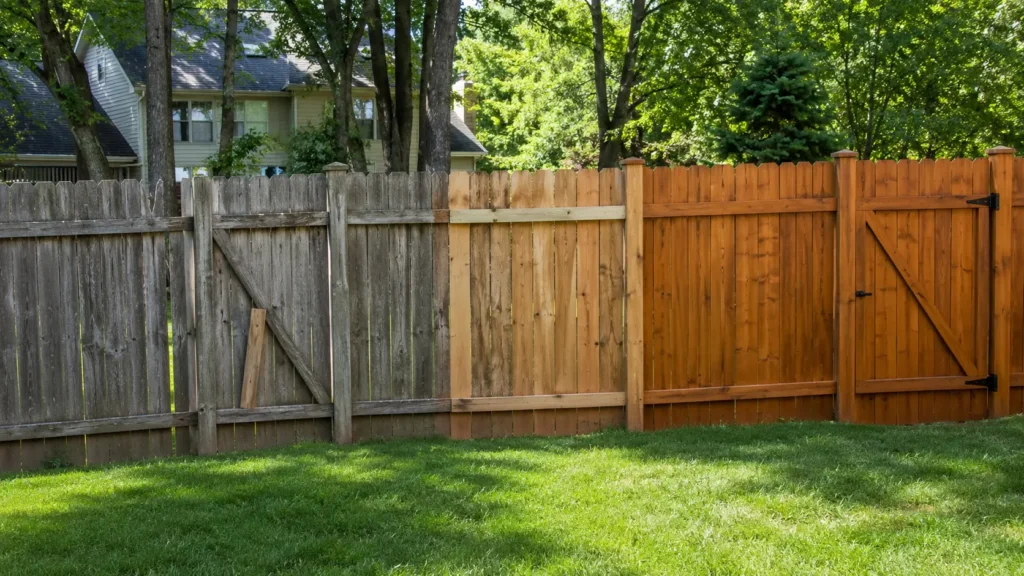
An older wood fence does not always need to be replaced right away. Sometimes a few repairs and a fresh stain can bring it back to a better condition. Other times, the posts, rails, or boards are too far gone for staining to make a real difference.
For North Carolina homeowners, wood fences deal with sun, rain, humidity, and seasonal moisture changes. Over time, that can lead to fading, splitting, warping, loose boards, soft wood, and leaning sections. The right choice depends on the fence’s condition, not just its age.
Before spending money on a full replacement, it helps to know the difference between a fence that needs repair, a fence that needs stain, and a fence that needs to be rebuilt.
Key Takeaways
- Repair may be enough if the damage is small and the fence structure is still solid.
- Staining can help protect and refresh wood, but it will not fix rot, leaning posts, or broken rails.
- Replacement may be the better option when damage is spread across several sections.
- The posts are usually the biggest clue. If the posts are weak, the rest of the fence may not last much longer.
- A fence contractor can inspect the structure and help you decide which option makes the most sense.
Start With the Fence Posts
Before looking at the boards, color, or surface wear, look at the posts. Fence posts carry the structure. If they are weak, leaning, loose, or rotting near the ground, staining the fence will not solve the real problem.
A wood fence may still look decent from a distance, but the posts can tell a different story. Push gently on different sections of the fence. If the fence moves too much, shifts at the base, or feels unstable, the issue may be structural.
Signs of post problems include:
- Posts leaning to one side
- Wood feeling soft near the ground
- Soil pulling away from the post base
- Sections moving when pushed
- Gates sagging because the post cannot support the weight
- Several panels no longer lining up straight
If one post is damaged, repair may be possible. If many posts are failing, replacement may be the smarter long-term choice.
When Wood Fence Repair May Be Enough
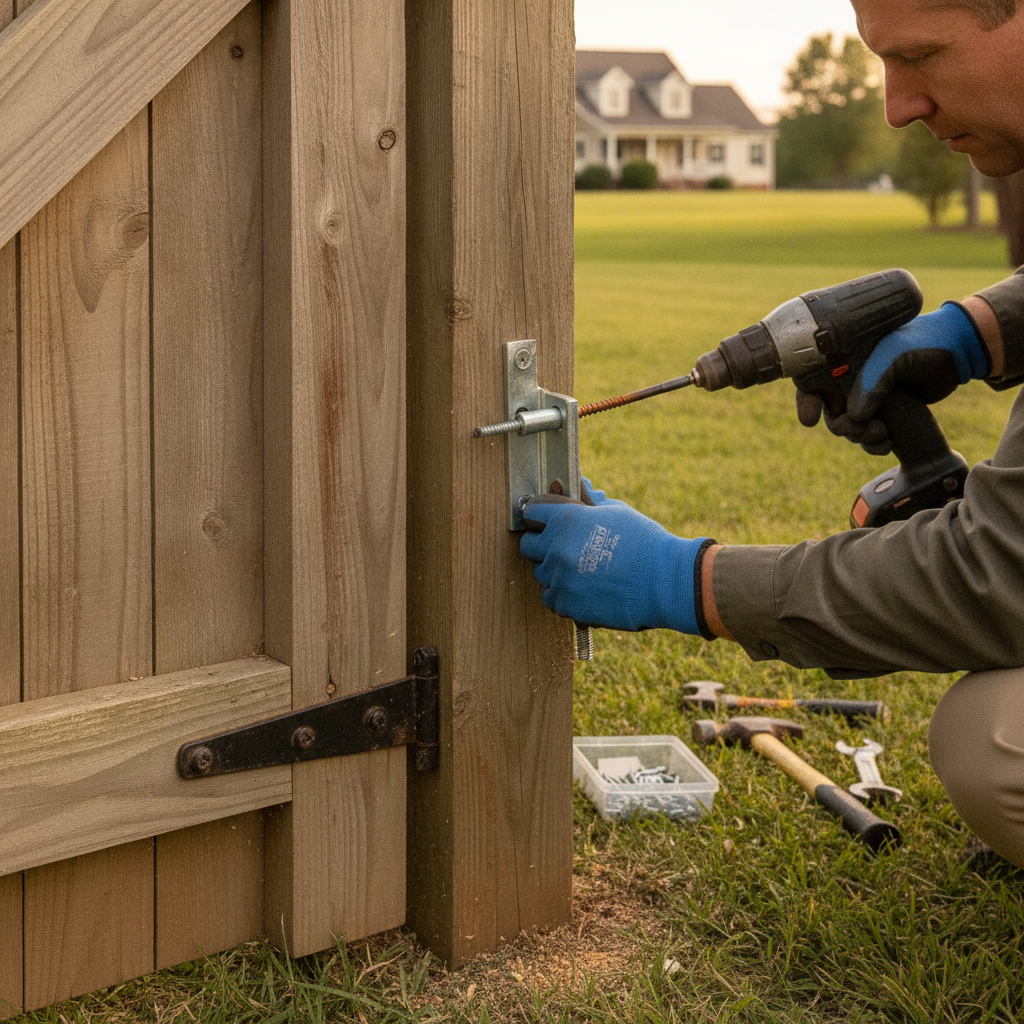
Fence repair makes sense when the damage is limited to one area and the rest of the fence is still strong. A fence does not need to be replaced just because one board is cracked or one gate has hardware issues.
Repair may be enough if you notice:
- A few broken or missing boards
- One loose rail
- A gate that needs adjustment
- One section damaged by weather or impact
- Loose screws, nails, hinges, or latches
- Minor warping in one area
- One or two posts that need attention
This type of damage is common with older wood fences. If the fence line is still mostly straight and the posts are solid, repairing the problem areas may extend the life of the fence.
A repair can also make sense if you are not ready for a full replacement but need the fence to stay safe, secure, or functional.
When Staining Makes Sense
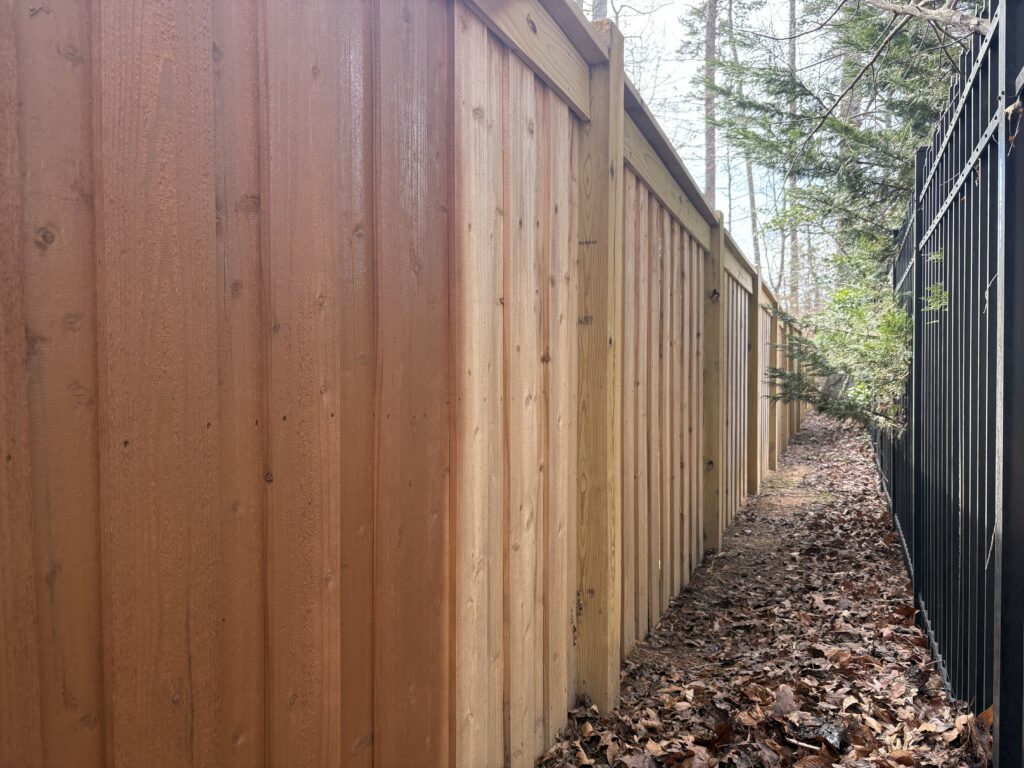
Staining is a good option when the wood fence is still structurally sound but needs protection or a refreshed look. It can help improve the appearance of faded wood and give the surface another layer of defense against weather exposure.
Staining may make sense if:
- The fence is faded but still strong
- Boards are dry but not rotted
- The fence line is straight
- Posts are firm
- Rails are still holding well
- The homeowner wants a cleaner, more finished look
- The fence has not been protected in a while
A stained wood fence can look cleaner and more intentional than a gray, weathered fence. For homeowners who like the look of wood, staining can be a practical way to maintain that natural style.
But staining should be done at the right time. If the wood is too wet, too dirty, or already damaged, the result may not last as well. The fence should be cleaned, checked, and prepared before stain is applied.
What Staining Cannot Fix
Staining is helpful, but it is not a repair method for structural damage. It will not turn weak wood into strong wood again.
Staining cannot fix:
- Rotten posts
- Broken rails
- Soft or crumbling boards
- Severe warping
- Leaning fence sections
- Loose gate posts
- Large gaps from shifting
- Boards pulling away from the frame
- A fence that moves when pushed
This is where some homeowners waste money. They stain a fence that looks old, but the real problem is not the color. The real problem is that the structure is failing.
If the wood is soft, rotten, or unstable, repair or replacement should be handled before staining is considered.
When Replacement Is the Smarter Option
Replacement usually makes more sense when the fence has widespread damage or the structure is no longer dependable. At that point, repairing one section may only delay the same problem from showing up somewhere else.
Fence replacement may be the better choice if:
- Several posts are leaning
- Multiple sections are unstable
- Wood is rotting near the ground
- Rails are pulling loose in different areas
- The gate keeps sagging after repairs
- Boards are warped across most of the fence
- The fence no longer provides privacy or pet containment
- Repairs are becoming frequent
- The fence is no longer safe or reliable
A full replacement can also be a good time to rethink the layout. If the old fence had poor gate placement, large gaps, awkward corners, or privacy in the wrong areas, replacement gives the homeowner a chance to fix those problems.
Instead of rebuilding the same layout, the new fence can be planned around how the yard is actually used.
Check the Rails, Not Just the Boards
Fence boards are easy to notice because they are visible. But the rails behind them are just as important. Rails help hold the boards in place and keep the fence section stable.
If the rails are damaged, boards may start to loosen, shift, or pull away.
Watch for:
- Rails that are cracked
- Rails separating from posts
- Boards that move because the rail behind them is weak
- Sections that look bowed or uneven
- Fasteners pulling out of the wood
- Rails sagging between posts
If only a rail or two is damaged, repair may be possible. If rails are failing throughout the fence, replacement may be more practical.
Look at the Gate Before Deciding
The gate is often the first part of an older wood fence to show problems. It moves more than the rest of the fence, carries extra weight, and depends heavily on strong posts.
A gate issue can sometimes be fixed with new hinges, latch adjustment, or post repair. But if the gate keeps failing, it may point to a bigger fence problem.
Look for:
- Gate dragging on the ground
- Latch not lining up
- Gate frame twisting
- Hinges pulling loose
- Gate post leaning
- Wide gaps around the gate
- Gate feeling too heavy for the post
If the gate problem is isolated, repair may be enough. If the gate is failing because the nearby posts and fence sections are weak, replacement may be the better answer.
How North Carolina Weather Wears on Wood Fences
Wood fences in North Carolina deal with a mix of moisture, heat, sun exposure, and humidity. Over time, those conditions can wear down unprotected or aging wood.
Common weather-related signs include:
- Fading from sun exposure
- Swelling after wet weather
- Splitting or checking
- Warping boards
- Mildew or dark staining
- Soft wood near the bottom
- Fasteners loosening over time
A fence in a shaded or damp area may age differently than a fence in full sun. Sections near trees, low spots, or drainage areas may show problems faster.
That is why one part of the fence may need repair while another part still looks fine.
Repair, Stain, or Replace: A Simple Way to Decide
Use the condition of the fence to guide the decision.
Choose Repair If:
- Damage is limited to one or two areas
- Posts are mostly firm
- The fence is still straight
- Boards and rails are mostly solid
- The gate problem is minor
- You want to fix function, not change the whole fence
Repair is usually the right first option when the fence still has a solid structure.
Choose Staining If:
- The fence is faded or dry-looking
- The wood is still firm
- Posts and rails are strong
- The fence does not lean
- There is no major rot
- You want to protect and refresh the wood
Staining works best when the fence is already in decent shape.
Choose Replacement If:
- Many posts are weak
- The fence leans in several areas
- Wood is soft or rotted
- Rails are failing throughout
- The gate keeps sagging
- Repairs are becoming too frequent
- The fence no longer does its job
Replacement is usually better when the damage is structural or widespread.
Do Not Judge the Fence by Color Alone
A gray or faded wood fence may look old, but that does not always mean it needs replacement. Some fences look weathered on the surface but still have strong posts, rails, and boards.
On the other hand, a fence can still have decent color but be weak near the ground.
That is why appearance alone is not enough. The most important questions are:
- Is the fence straight?
- Are the posts firm?
- Is the wood solid?
- Does the gate work?
- Are repairs isolated or widespread?
- Is the fence still doing what you need it to do?
A fence that looks tired may only need cleaning and staining. A fence that feels unstable may need repair or replacement, even if it still looks acceptable.
When Partial Replacement Makes Sense
Sometimes the answer is not full replacement. A homeowner may only need to replace one side of the fence, one damaged section, or one gate area.
Partial replacement may make sense if:
- One side has more sun or water damage
- A tree damaged a specific section
- One neighbor-facing side needs privacy
- A gate area is failing
- The rest of the fence is still strong
- The homeowner wants to phase the project
The challenge is matching old and new materials. Fresh wood will usually look different from older wood at first. Over time, color may blend more, especially if staining is planned.
A contractor can help explain whether partial replacement will look acceptable and function well.
Questions Homeowners Should Ask Before Spending Money
Before deciding, ask these questions:
Is the fence still stable?
If the fence moves too much when pushed, the structure should be inspected.
Are the posts solid at the ground?
Post condition is one of the most important signs.
Is the damage in one area or across the fence?
Small isolated damage points toward repair. Widespread damage points toward replacement.
Is the fence worth staining?
If the wood is solid, staining may help. If the wood is rotted, staining is not enough.
Does the gate still work correctly?
A bad gate may be a small hardware issue or a sign of weak support.
Are you happy with the current layout?
If the layout is awkward, replacement may be a chance to improve gates, privacy, and access.
Common Mistakes to Avoid
Homeowners often spend money in the wrong order. The biggest mistake is improving the appearance before checking the structure.
Avoid these mistakes:
- Staining over rotten wood
- Replacing boards while ignoring weak posts
- Repairing the same gate repeatedly without checking the post
- Assuming faded wood always needs replacement
- Ignoring drainage near the fence line
- Waiting until a leaning section becomes unsafe
- Replacing the whole fence without asking if partial replacement could work
- Choosing a new fence without fixing the old layout problems
A smart decision starts with inspection, not guesswork.
When to Call a Fence Contractor
It may be time to call a fence contractor if:
- You are unsure whether the fence is worth saving
- Posts are leaning or loose
- Wood feels soft near the ground
- The gate will not stay aligned
- Several boards or rails are failing
- You want to stain but are not sure the fence is ready
- You are considering partial replacement
- The fence no longer provides privacy, security, or pet containment
A contractor can look at the posts, rails, boards, gate, and layout before recommending repair, staining, or replacement.
Final Thoughts
An older wood fence does not always need to be replaced. If the structure is solid, repair and staining may be enough to improve the fence and extend its usefulness. But if posts are weak, rails are failing, or damage is spread across several sections, replacement may be the better long-term choice.
The right decision depends on what is actually wrong with the fence. Surface wear, loose boards, fading, rot, and structural movement all point to different solutions.
Apex Fencing helps homeowners in Asheboro and nearby North Carolina communities inspect older wood fences and decide whether repair, staining, or replacement makes the most sense. Whether the fence needs a few fixes, a fresh stain, or a new layout, the goal is to choose the option that gives the property a stronger and more useful fence.