
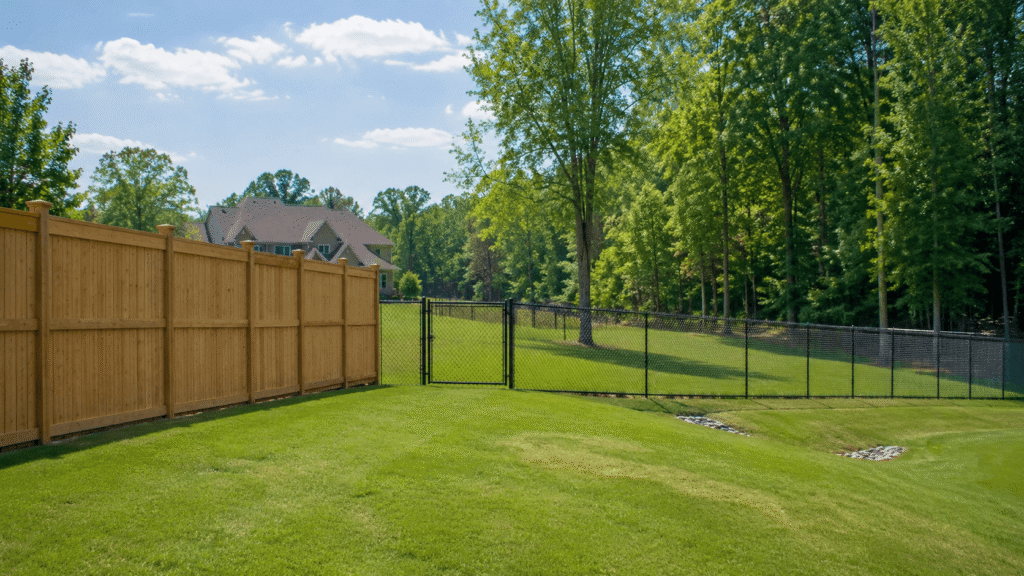
A backyard that backs up to woods, open land, or a neighboring field needs a different fence plan than a yard surrounded by houses on every side. The fence may need to keep pets in, mark the property line, add privacy, control access, or make the yard feel more finished without blocking the natural view.
For many North Carolina homeowners, the challenge is finding the right balance. A full privacy fence may feel too closed off if the yard backs up to trees or open land. But a completely open fence may not give enough privacy, security, or pet control.
The best choice depends on what the fence needs to do and how the property is used every day.
Key Takeaways
- Homes that back up to woods or fields need a fence plan based on privacy, pets, visibility, and property boundaries.
- Chain link can work well for long, practical boundaries where visibility matters.
- Wood or vinyl may be better where privacy is needed near patios, pools, or neighbors.
- Aluminum can define the yard without blocking open views.
- A mixed fence layout can work better than using one material across the whole property.
Start With the Main Reason for the Fence
Before choosing a fence material, homeowners should decide what problem they are trying to solve.
A backyard that backs up to woods or open land may need a fence for several reasons:
- Keeping dogs in the yard
- Creating a clear property boundary
- Blocking views from a neighboring field
- Adding privacy near a patio or pool
- Keeping children away from wooded areas
- Making the yard feel more finished
- Protecting a garden or outdoor space
- Separating the backyard from brush, trees, or uneven ground
- Improving security around the home
Not every property needs the same type of fence. A homeowner who wants to keep dogs contained may need a different layout than someone who wants privacy from a neighboring field. A homeowner who wants to preserve a wooded view may not want a tall solid fence across the back of the yard.
The purpose should guide the design.
Chain Link Works Well for Practical Boundaries

Chain link can be a strong option for homes that back up to woods, fields, or larger open lots. It creates a clear boundary without fully blocking the view.
This can be useful when homeowners want to see through the fence while still keeping pets or children inside the yard.
Chain link may work well if:
- The backyard is large
- The fence line is long
- The property backs up to woods
- Visibility matters
- The homeowner wants a practical boundary
- Pets need containment
- The fence is not meant to provide full privacy
- The homeowner wants the yard to stay open visually
Black-coated chain link can look cleaner and blend better with trees, grass, and landscaping than older silver chain link. For wooded or open areas, that can help the fence feel less noticeable.
Chain link may not be the right choice if the main goal is privacy. But for boundary, pet control, and visibility, it can be a practical option.
Wood Fencing Adds Privacy and a Natural Look
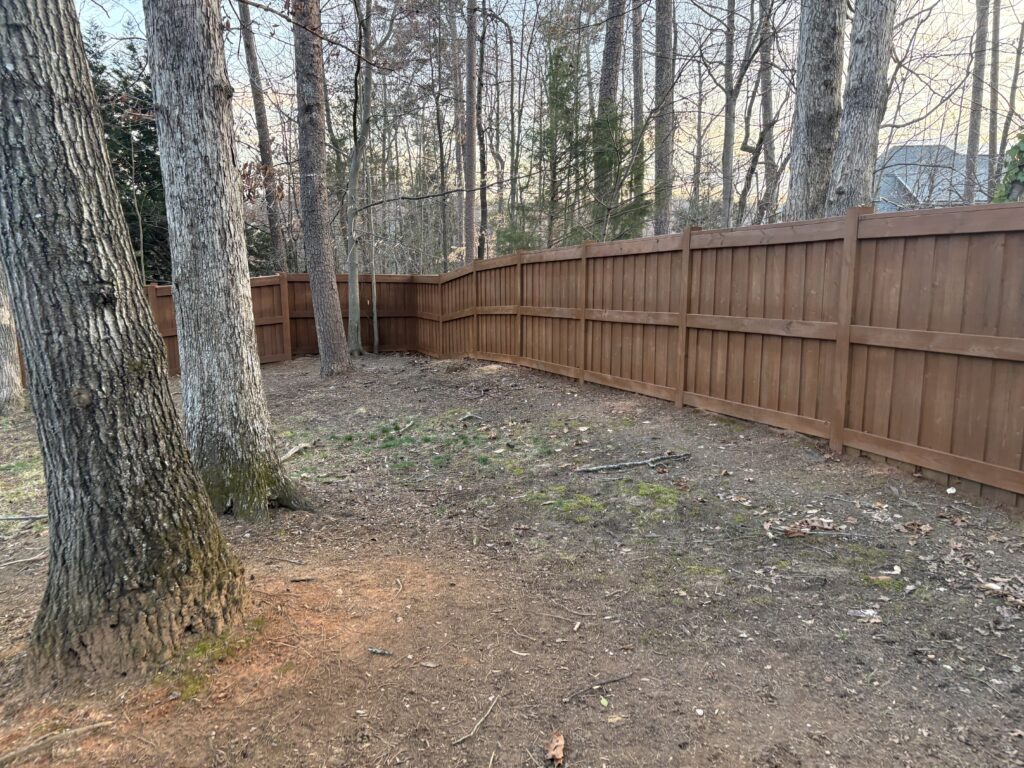
Wood fencing can be a good choice when the homeowner wants privacy or a warmer look that fits a natural setting. For homes that back up to trees or fields, wood can feel more blended with the landscape than a bright or highly decorative fence.
Wood may be a good option if:
- The yard needs privacy from one side
- The home backs up to another property
- The homeowner wants a natural appearance
- The fence will be stained
- The backyard has patios, decks, or outdoor seating
- The homeowner wants to block an unattractive view
- The fence should feel more traditional
Wood privacy fencing can work especially well near patios, pools, and neighbor-facing areas. It can also help make a backyard feel more private if the property backs up to an open field where people can see across the yard.
The main thing to remember is maintenance. Wood can be affected by sun, moisture, and age, especially near trees or damp areas. Staining can help protect the fence and keep the wood looking more finished.
Vinyl Can Create a Clean Privacy Barrier

Vinyl fencing can work well when the homeowner wants solid privacy with a clean, uniform look. It is often used along neighbor-facing sides, pool areas, side yards, and spaces where the homeowner wants a stronger visual screen.
Vinyl may make sense if:
- The backyard needs a full privacy section
- The homeowner wants a clean appearance
- The fence is near a patio or pool
- The property backs up to a road, field, or neighboring lot
- The homeowner wants less routine maintenance than wood
- A solid panel look fits the home
For a yard that backs up to woods, vinyl may not always be needed across the entire back line. It may feel too solid if the homeowner wants to keep the wooded view.
A better approach may be to use vinyl where privacy matters most, then use a more open material in areas where the view should remain.
Aluminum Keeps the Yard Open
Aluminum fencing is a good option when homeowners want a finished look without closing off the backyard. It can define the space while keeping the view of woods, landscaping, or open land.
Aluminum may work well if:
- The homeowner wants curb appeal
- The yard backs up to a nice wooded view
- Full privacy is not needed
- The fence is near a pool or garden
- The homeowner wants an open, clean look
- Visibility is important
- The yard should still feel spacious
Aluminum does not provide privacy, so it is not the best fit if the goal is to block neighbors or road views. But it can be a strong choice when the homeowner wants a boundary that does not make the yard feel smaller.
For homes with scenic backyards, aluminum can help keep the view open while still giving the property a more finished fence line.
A Mixed Fence Layout May Work Best
Homes that back up to woods, fields, or open lots often need more than one type of fence. One side of the yard may need privacy, while another side may only need a boundary.
A mixed layout may include:
- Wood privacy fence near a patio
- Vinyl privacy fence along a neighbor-facing side
- Chain link along a wooded back line
- Aluminum near a pool or garden
- A custom gate near the driveway
- A wider gate for mower or equipment access
This approach keeps the fence practical. The homeowner does not have to install full privacy fencing everywhere if only one section needs it.
A mixed layout can also help the backyard feel more natural. Solid fencing can be used where privacy matters, while open fencing can preserve views where privacy is not needed.
Think About Pets Before Choosing the Fence
For many homeowners, pets are the main reason for installing a backyard fence. If the yard backs up to woods or open land, pet planning becomes even more important.
Dogs may react to:
- Wildlife
- People walking near the property
- Neighboring animals
- Open field movement
- Sounds from wooded areas
- Other dogs
- Vehicles or equipment nearby
Fence planning for pets should consider:
- Fence height
- Bottom gaps
- Gate latches
- Gate gaps
- Digging behavior
- Jumping behavior
- Visibility through the fence
- Fence strength
- Where the dog usually runs
Some dogs do well with open fencing. Others may need privacy fencing to reduce visual triggers. Some may need extra attention around gates and low spots.
The best pet fence is not just about material. It is about matching the fence to the dog’s behavior and the yard’s layout.
Watch for Low Spots and Drainage Areas
Backyards near woods or open land may have uneven ground, natural drainage paths, or low areas where water collects. These areas matter when planning a fence.
Low spots can create:
- Gaps under the fence
- Soft soil near posts
- Water pooling around the fence line
- Areas where pets may dig or push under
- Uneven fence lines
- Gate problems if the ground shifts
Before installing a fence, homeowners should pay attention to where water flows after rain. A fence placed across a problem drainage area may need extra planning.
This is especially important for wood fences because moisture near the ground can affect posts and lower boards over time. But all fence types depend on solid posts, so drainage should be considered no matter what material is chosen.
Do You Want to Keep the View?
One of the biggest questions for homes that back up to woods or open land is whether the homeowner wants to keep the view.
If the backyard has a wooded edge, open field, or natural area, a solid privacy fence may block something the homeowner actually enjoys.
Ask these questions before choosing a fence:
- Do you like the wooded view?
- Do you want to see across the field?
- Do you need to block only one side?
- Is the view better from the patio or from inside the home?
- Would a solid fence make the yard feel smaller?
- Would an open fence still solve the main problem?
If the view is part of what makes the property feel special, open fencing or a mixed layout may be better than full privacy fencing.
Privacy May Only Be Needed on One Side
A common mistake is assuming the whole backyard needs the same fence. For many homes, privacy is only needed in one or two areas.
For example:
- A neighbor-facing side may need a wood privacy fence.
- The back line facing woods may only need chain link.
- A patio corner may need a vinyl privacy section.
- A pool area may need a combination of privacy and open fencing.
- A driveway side may need a gate and short privacy run.
This kind of layout is often more useful than wrapping the entire yard with one solid fence style.
Privacy should be placed where it solves a real problem. The rest of the yard can stay open, practical, and easier to maintain.
Plan Gate Access Carefully
Gate placement matters on any fence project, but it is especially important for larger backyards, wooded lots, and open properties.
A good gate plan should consider:
- Mower access
- Trash bin movement
- Garden access
- Shed access
- Driveway connection
- Pet areas
- Utility access
- Equipment access
- Paths to wooded or open areas
If the yard is larger, one small walk-through gate may not be enough. A wider gate may be needed for lawn equipment or outdoor projects.
The gate should be placed where it makes daily use easier, not just where it fits into the fence line.
Fence Options by Homeowner Goal
Here is a simple way to think about fence choices.
If You Want Pet Containment
Consider chain link, vinyl, wood, or aluminum depending on the dog’s size and behavior. Pay close attention to gates and bottom gaps.
If You Want Privacy
Wood or vinyl usually makes more sense. Use privacy fencing where the view needs to be blocked.
If You Want to Keep the View
Aluminum or chain link may be better. These options define the yard without closing it off.
If You Want a Natural Look
Wood can fit well with wooded properties, especially when stained.
If You Want a Practical Long Boundary
Chain link may be a good option for longer fence runs along woods or open land.
If You Want a More Finished Backyard
A mixed layout can define the yard, add privacy where needed, and keep open areas from feeling closed in.
Common Mistakes to Avoid
A backyard that backs up to woods or open land can be harder to plan than it looks. Avoid these common mistakes:
- Choosing full privacy fencing without thinking about the view
- Ignoring pet behavior
- Forgetting about low spots and drainage
- Using one fence material everywhere
- Placing gates too far from where they are needed
- Not planning for mower access
- Building around trees without considering roots and growth
- Blocking airflow and sunlight where they matter
- Choosing a fence only by appearance
- Treating the back fence line the same as the side fence lines
The right fence should match the property, not just the catalog photo.
Questions to Ask Before Choosing a Fence
Before deciding, homeowners should ask:
What am I trying to keep in or keep out?
Pets, children, views, neighbors, and access all lead to different fence choices.
Do I want privacy or visibility?
This is one of the biggest decisions for yards that back up to woods or fields.
Which part of the yard needs the most privacy?
Privacy may only be needed near a patio, pool, or neighbor-facing side.
Will pets dig, jump, or react to movement?
Pet behavior should affect fence height, material, and gate planning.
Where does water collect after rain?
Drainage can affect posts, bottom gaps, and long-term fence performance.
Where should the gates go?
Gates should match how the yard is actually used.
Should I use more than one fence material?
A mixed layout can often solve more problems than one material alone.
When a Custom Fence Layout Makes Sense
A custom layout may be the best choice if the backyard has:
- Woods behind the property
- A neighboring field
- A large or uneven yard
- Pets
- A pool or patio
- One exposed side
- Drainage areas
- Tree roots near the fence line
- A long back boundary
- Different privacy needs on different sides
- Multiple access points
In these cases, a standard fence plan may not give the best result. A custom layout can help the fence fit the land and the way the homeowner uses the space.
Final Thoughts
Homes that back up to woods, open lots, or neighboring fields need a fence plan that balances privacy, visibility, pets, access, and property boundaries. A full privacy fence may work in some areas, but it is not always needed across the entire yard.
Chain link can be practical for long boundaries. Wood and vinyl can add privacy where it matters. Aluminum can keep the view open while making the yard feel finished. A mixed layout can bring these options together in a way that fits the property better.
Apex Fencing helps homeowners in Asheboro, Randolph County, and nearby North Carolina communities choose fence layouts that match the land, the view, and the way the backyard is used.